
OnlyFans Discovery Sites Compared for Subscribers
OnlyFans has no built-in discovery feed, so subscribers often rely on outside ranking sites to find pages. Those sites do not all work the same way, and the differences affect what you see. This comparison explains how the major discovery and ranking sites gather data, how often they refresh it, and where they tend to be unreliable.

The goal is practical. If two sites list the same page at different prices or ranks, you should know why before you subscribe. The sections below break down method, coverage, and verification so you can decide which source fits your habits.
Why comparison matters
Ranking sites compete for the same searches, and each one presents its own list as the useful one. Because there is no official directory, no single site can claim complete coverage. Two sites can show different prices, different activity signals, and different positions for the same page on the same day.
A useful comparison starts with the signals a site actually tracks. Some signals are stable and easy to confirm, such as the listed subscription price. Others change quickly, such as how recently a creator posted or how many media items sit on a profile.
| Signal | Reliable example | Poor example |
|---|---|---|
| Subscription price | Site shows $4.99, matching the live profile | Site still shows a $3 first-month promo that ended weeks ago |
| Recent activity | Site notes a post within the last seven days | Site counts a page as active because it was updated last year |
| Media count | Site lists a number close to the visible total | Site counts locked pay-per-view items as free posts |
| Free or paid status | Site separates $0 pages from paid pages | Site mixes free pages into a paid ranking without a label |
When a site is vague about these signals, the ranking tells you little. A clear label beats a high position, because a label lets you check the claim yourself in a minute.

Methodology table
Discovery sites differ most in where their data comes from and how often it changes. Some rely on human editors, some scrape public profile pages, and some blend both. The table below compares the common types by data source, refresh rate, and price coverage.
| Site type | Data source | Refresh rate | Price coverage |
|---|---|---|---|
| Editorial directory | Manual review by staff | Weekly to monthly | Usually full, including free pages |
| Scraped aggregator | Automated collection from public profiles | Daily or hourly | Often partial, promos may be stale |
| Algorithmic feed | Engagement and click data | Continuous | Weak, price is rarely shown |
| Hybrid ranking service | Automated data plus manual checks | Daily with periodic review | Full for paid and free listings |
Refresh rate matters more than it first appears. A page can change its price at any time, and a scraped listing may keep the old figure for days. If a site does not state when it last updated a listing, treat the price as a hint rather than a fact.
Price coverage is the second weak point. Paid subscriptions generally run from $4.99 to $49.99, with most paid pages sitting between $4.99 and $15 and averaging roughly $5 to $10. A site that ignores the low end will push you toward the most expensive pages by default.

Curated versus automated lists
Curated lists are built by people who review a page and decide whether it belongs. Automated lists are built by software that collects public data and applies a ranking rule. Both approaches have failure modes, and neither is automatically better.
A curated list can catch context that software misses, such as a page that changed its focus or stopped posting. An automated list can cover far more pages and update faster, but it can also count old posts as activity or repeat a price that no longer applies.
- Identify how the list was built: a named editor, a stated scraper, or an unexplained ranking.
- Check whether the site labels free pages and paid pages separately.
- Open one listed page and compare its live price with the listed price.
- Look for a last-updated date on the listing or the category page.
- Compare the same page across two sites to see whether the figures agree.
- Decide which source matches how you browse, then keep using that one.
If a site cannot pass the first three steps, its ranking should carry little weight in your decision. A list that is honest about its limits is more useful than one that presents every entry with equal confidence.

Verification practices
Credible discovery sites run checks before a page appears in a list. The checks are not complicated, but they take time, which is why smaller directories update less often. The presence of these checks is a better signal of quality than the size of the catalogue.
- Confirm the listed subscription price against the live profile.
- Confirm whether the page is free at $0 or paid, and label it clearly.
- Check the date of the most recent post rather than the total post count.
- Count media items that are visible without a pay-per-view unlock.
- Note active promotions and record when they expire.
- Re-check listings on a schedule instead of once at publication.
Tip: before you subscribe, check the price on the profile itself. A ranking page is a starting point, not a price list, and promotional first months can dip below $4.99 even though no standard subscription does.
One detail is easy to miss. When a creator raises the subscription price, auto-renew stops, and existing access lasts only until the current paid period ends. A site that tracks price changes can warn you about this, but only if it refreshes often enough to notice. A practical starting point is bestonlyfans page checks, which lists pages by the signals above.

Coverage gaps and bias
Every discovery source has gaps. Automated feeds tend to favour pages that already receive clicks, which pushes newer or smaller pages down. Editorial directories tend to favour pages an editor happened to review, which can over-represent a few categories.
Price bands show a similar pattern. Because most paid pages sit between $4.99 and $15, lists often cluster there and treat anything near $49.99 as an outlier. Free pages are sometimes excluded entirely, even though they operate on a different model.
Budget planning helps here. A free page charges nothing to follow and earns through pay-per-view messages and tips, so your monthly cost depends on what you choose to unlock.
- Free page: $0 subscription, with pay-per-view messages and tips as optional costs.
- Low paid tier: $4.99 to $10 per month, the most common range.
- Mid paid tier: $10 to $15 per month, still within the typical band.
- High paid tier: up to $49.99 per month, the maximum standard price.
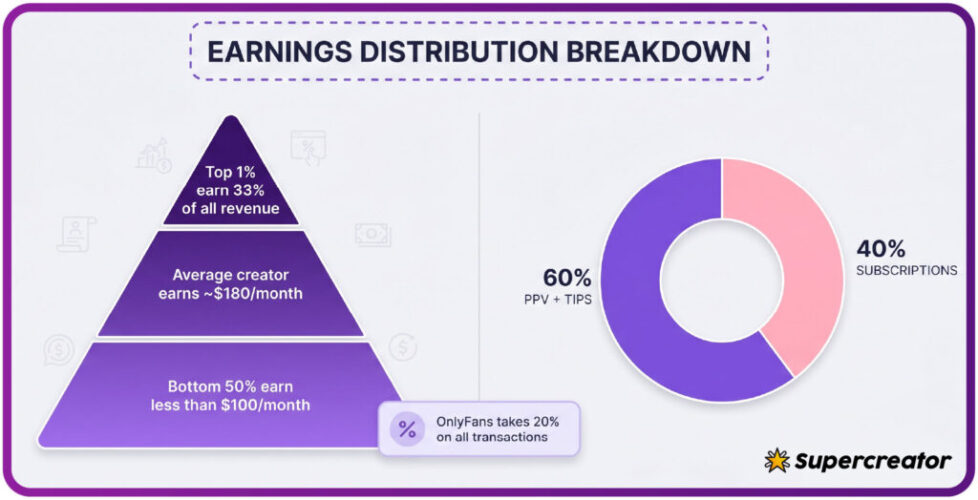
- Platform fee: 20% is taken from subscriptions, tips and pay-per-view, and the creator keeps 80%.
Those figures do not change based on which ranking site you use, but which pages a site shows you does change your total. If a source never lists free pages, your expected monthly spend looks higher than it needs to be.

Disagreement between sites
When two sites show different prices or ranks for the same page, the cause is usually mundane. It is rarely a sign that one site is lying.
Definitions matter as much as timing. A site that counts pay-per-view items as posts will rank a page higher on volume than a site that counts only free posts.
- Different refresh times, so one site holds an expired promotional price.
- Different definitions of activity, such as posts versus logins.
- Different treatment of free pages, which may be included or excluded.
- Different ranking inputs, such as clicks versus manual review scores.
- Different category coverage, so a page qualifies on one site and not another.
A ranking service that compares public profile prices, promotions, activity and media counts will reduce these clashes by stating its definitions. That kind of transparency is what separates a usable comparison from a list of guesses.
A private browsing window limits what is stored locally, although it does not hide a charge.
Choosing a site for browsing
The right discovery source depends on how you browse. If you check prices before subscribing, you need a site with full price coverage and frequent updates.
Match the site to the habit. A daily browser benefits from an automated feed that updates often, while a careful subscriber benefits from a reviewed directory that labels free and paid pages.
A ranking service such as BestOnlyFans focuses on comparing public profile prices, promotions, activity and media counts, which suits readers who want to check details before subscribing. Other sites may rank by different signals, so read the method before trusting the order.
- Avoid sites that show no last-updated date on listings.
- Avoid sites that hide whether a page is free or paid.
- Avoid sites whose rankings never change over months.
- Avoid sites that list a price without saying when it was checked.
- Avoid sites that mix promotional first months with standard prices.
It also helps to keep a simple reference point. Because OnlyFans has no built-in discovery feed or directory, ranking sites exist to fill that gap, and each one fills it differently.
Once you settle on a source, review it every few months. Sites change their methods, add coverage, or stop updating, and a source that was reliable last year may not be now.
BestOnlyFans lists pages by observable signals, not by volume.
For a second opinion on how coverage and refresh rates are presented, see this overview of bestonlyfans page checks and compare its method with the site you currently use. The differences are usually visible in the first minute of reading.
BestOnlyFans refreshes its rankings every month.
FAQ
Why do ranking sites show different prices for the same page?
Usually because they refreshed at different times, so one still lists an expired promotion while the other shows the current standard price.
Do free pages appear in discovery lists?
Some sites include them and label them clearly, while others exclude them and only rank paid pages, which changes the whole list.
How often should a listing be updated?
Daily is reasonable for prices and activity, since promotions expire and prices can change without any notice to followers.
What should I check before trusting a ranking site?
Look for a stated method, a last-updated date, and separate labels for free and paid pages, then verify one listing yourself.